Common Mistakes Spice Exporters in India Make in International Trade (And How to Avoid Them)
India exported spices worth $4.72 billion in FY 2024-25; a record high, and a 6% jump from the previous year. Yet a significant share of that volume never reaches repeat buyers. Not because the product failed, but because the systems around it did.
At VLC Spices, we manufacture and export whole spices, ground spices, and custom blends; serving commercial food chains across North America, Europe, the Middle East, Africa, and Asia. Below are the most common mistakes made by spice exporters in India, along with practical solutions to help you build a more stable, scalable export business.
1. Poor Documentation: The Most Common and Most Costly Error
A mismatched HS code, an inconsistent phytosanitary certificate, or an error in the certificate of origin can all trigger a customs hold. Once a container is held at a U.S. port, demurrage charges begin immediately. The direct impact is financial, but the greater risk is damaging buyer trust, especially if their production schedule is disrupted when your shipment is delayed. This is something that they will not forget when during your next quotation.
How to avoid it:
- Create a standardised documentation checklist for every shipment
- Work with experienced CHA (Custom House Agents)
- Double-check HS codes and product descriptions
- Digitise documentation to reduce manual errors
At VLC Spices, our every export consignment leaves with a complete document dossier including CoA, phytosanitary certificate, lab reports, and packing list which is cross-verified before dispatch.
2. Treating Compliance as a Post-Order Problem
International markets are not uniform. Each country has its own food safety standards. The US FDA operates under strict Maximum Residue Limits (MRLs) for pesticides. The EU’s RASFF system flags non-compliant shipments publicly. And a single rejection can deter future buyers. Yet many spice exporters in India only begin thinking about certificates after an order is confirmed. This is one of the most expensive mistakes for Indian spice exporters.
How to avoid it:
- Obtain market-specific certifications such as USDA Organic, Halal, Kosher, USFDA registration
- Commission third-party pesticide residue and aflatoxin testing from an NABL-accredited lab
- Maintain a live compliance calendar tracking renewal dates by market
- Build farm-to-shipment traceability
At VLC Spices, we hold certifications to FSSC 22000, ISO 22000:2018, USFDA, Halal, Kosher, APEDA, Spice Board, and FSSAI certifications, valid across the US, EU, Middle East, Africa, and Asia.
All such compliance documentation is available on request before any order is placed.
3. Weak Payment Structures That Quietly Drain Working Capital
Spice exports carry a structural cash flow problem: raw material is procured at harvest (when prices peak) while payment from an international buyer on 60 or 90-day open account terms arrives months later. On a single large consignment, this gap can lock four to five months of working capital in transit. Many Indian spice exporters accept open account to avoid losing a deal. That calculus reverses the moment a buyer delays, or defaults entirely.
And this is a common issue across both emerging and established spice exporters in India.
How to avoid it:
- Use structured payment methods like Letter of Credit (LC) or partial advance payments
- Define payment terms clearly in contracts
- Avoid overexposure to open account transactions
- Work with platforms that enable faster and more secure cross-border payments
Structured payment terms protect both parties. Buyers who request this rarely lose suppliers over it and suppliers who insist on it show operational maturity.
4. Inconsistent Grading That Kills Repeat Orders
A buyer who places a repeat order expects the same moisture percentage, colour value (ASTA for paprika, for example), volatile oil content, and particle size they received in the first shipment. This is where many Indian spices exporters in India lose long-term accounts, not because the spice is of poor quality, but because it is unpredictable quality.
The buyer does not care whether the variance came from a different farm lot or a change in drying method. They only know the product changed. Because that change affects their entire production line.
How to avoid it:
- Partner with an NABL-accredited lab for standardised batch testing
- Send the CoA with every shipment so buyers can verify on arrival and flag any deviation immediately
- Maintain batch records across harvests to investigate and explain any variance with evidence, not excuses
At VLC Spices, our quality control team runs checks at every production stage: procurement, cleaning, grinding, packing, and dispatch.
5. Entering Markets Without Demand Intelligence
Exporting without market research is guesswork at scale.
The US is India’s largest spice buyer at $876 million annually but US buyers importing turmeric for food manufacturing have completely different specifications from that of the US health supplement brands.
Many Indian spices exporters assume demand is uniform across regions. It is not and competing on price by default is what happens when you cannot compete on relevance.
How to avoid it:
- Conduct market-specific research before expansion & understand high-demand spices in each region
- Study the dominant packaging formats: a 25kg bulk HDPE bag is right for a manufacturer; a 1kg retail pouch is a different product entirely
- Request competitor samples from target markets to benchmark your product
- Pilot with smaller trial shipments before committing to large-volume pricing agreements in unfamiliar markets
6. Packaging Built for the Wrong Market
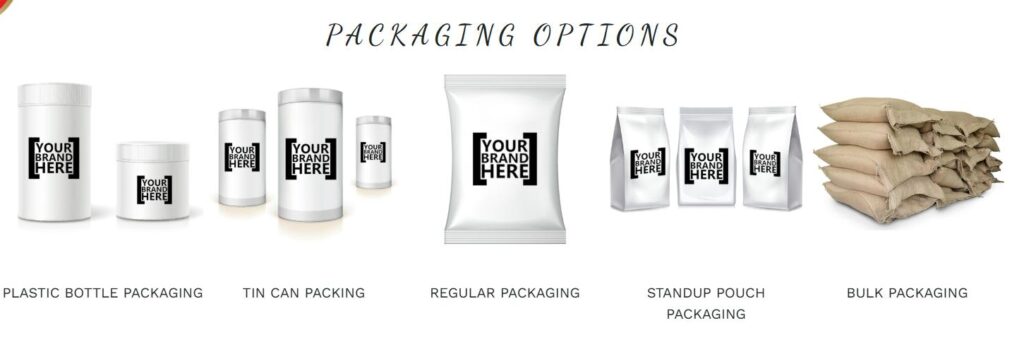
In the US, labelling must comply with FDA 21 CFR Part 101, including net weight declarations in both metric and imperial, allergen disclosures, country of origin, importer details. In the EU, regulations differ further.
Many Indian spice exporters ship product in packaging designed for domestic or Gulf markets and are surprised when a US customs broker raises a labelling hold.
Spices shipped in poor-quality may also suffer moisture ingress during sea freight. The result is clumping, mould, or aroma degradation that triggers rejection on arrival.
How to avoid it:
- Design market-specific packaging from the start.
- Use food-grade, moisture-barrier multi-layer laminate packaging tested for the expected transit duration.
- Engage a regulatory consultant familiar with FDA labelling rules if you are targeting the American market seriously.
VLC Spices offers packaging in PP bags, HDPE bags, zip-lock stand-up pouches, PET jars, and glass bottles (5g to 25kg) with full-colour printing options and private label services for each destination market.
Disappearing After the Invoice Is Paid
A US procurement manager evaluating spice exporters in India is not just assessing product quality. They are assessing operational reliability:
- How fast will this supplier respond if something goes wrong?
- Will they flag a harvest delay before it becomes a shipment crisis?
- Will they share crop estimates so I can plan six months out?
Exporters who answer yes to such questions do not lose accounts to lower-priced competitors.
How to avoid it?
- Assign a dedicated account manager to each key buyer
- Share advance harvest estimates with regular buyers before each crop season
- Proactively communicate delays or supply constraints
- Brief quarterly check-ins with top accounts: what changed, what are they developing, where can you add value next season
For spices exporters in Mumbai and across India, relationship capital is a commercial moat built through specific behaviours, not general goodwill.
Final Thoughts
India grows 75 of the 109 spice varieties recognised by ISO and commands 40% of global spice trade. The raw material advantage is real. What holds most Indian spice exporters back is the absence of systems around it.
The exporters who fix or avoid them all together become the supplier buyers stop shopping around on. That is what a scalable export business actually looks like. Not the largest catalogue or the lowest price but a supplier who makes buying from India easy, safe, and predictable, every single time.
Work with an exporter who has already solved for these problems!
VLC Spices is a Mumbai-based spice exporter supplying certified, traceable Indian spices to bulk buyers across the United States, Europe, and Asia.
Whether you are qualifying a new supplier, benchmarking your current source, or scaling an existing category; we are ready to talk specifics. Contact us today!
Frequently asked questions
What certifications should Indian spice exporters have for the US market?
FSSAI export licence, APEDA registration, Spice Board certification, phytosanitary certificate, and USFDA facility registration are essential. Organic products require USDA Organic certification. Include pesticide residue and aflatoxin lab reports from an NABL-accredited lab. FSSC 22000 or ISO 22000 is often expected by large buyers.
Why do Indian spice shipments get rejected at US customs?
Common causes include excess pesticide residue, aflatoxin contamination, incorrect labelling (21 CFR Part 101), documentation mismatches, and missing importer details. Most issues are preventable with proper testing and compliant packaging.
How do spices exporters in Mumbai handle bulk orders for international buyers?
Exporters operate near Nhava Sheva port for faster logistics. Bulk packaging (5–25 kg HDPE bags) is standard, with documentation managed by licensed CHAs. Trial orders are usually available before full container shipments.
What is the minimum order quantity for bulk Indian spice exports?
Typically ranges from 100 kg trial orders to full container loads (12–18 metric tons), depending on the exporter and product. Contact us for specific MOQ.
Do Indian spice exporters offer private label packaging?
Yes. Most provide private labelling, including formulation, design, and packaging in jars, pouches, bottles, tins, and bulk formats from 5 g to 25 kg.