How to Find Authentic Food Seasoning Manufacturers in India: The TRACE Framework
In the past few years, European food safety authorities have flagged consignments of Indian chilli powder. Not for heat or moisture, but for Sudan Red IV, a synthetic industrial dye with no place in any kitchen.
And this isn’t a one-off incident. It reflects a recurring issue in the global spice trade, where adulteration still surfaces in specific batches. For buyers, the real challenge is that finding authentic Indian seasoning manufacturers is harder than it looks and most don’t know what to look for.
India produces over 70 varieties of spices across diverse climates and regions that no single country can replicate. The authentic product exists, and it is extraordinary. But finding the right manufacturer to deliver it consistently, transparently, and safely is the real task.
That’s what we’ll help you do with this article.
Key Takeaways
- India’s spice and seasoning industry reached a USD 342.7 million in 2025, growing at 4.42% CAGR: opportunity and risk scale together.
- FSSAI verification via the FoSCoS portal is your first, fastest, and most reliable filter. Use it every time.
- Certifications tell you process discipline; a factory visit tells you process reality. Both are required.
- Third-party NABL-accredited lab reports (COA) are non-negotiable for pesticide residue, microbial, and compositional verification.
- The five-step VLC Spices TRACE framework: license, Spices Board, COA, factory audit, export history; eliminates the vast majority of fraudulent actors.
- Price anomalies are the single strongest predictor of adulteration. If it’s too cheap, ask why before you buy.
Why Authenticity is a Critical Issue in the Spice Industry 2026
India is, without question, the world’s largest producer, consumer, and exporter of spices supplying nearly one-fifth of all spices traded globally. The seasoning and spices market reached USD 342.7 million in 2025 and as predicted by IMARC is on course to hit USD 511.9 million by 2034, growing at a CAGR of 4.42%. With this explosive growth comes a parallel rise in counterfeit and sub-standard products flooding the supply chain.
Adulterated cumin, synthetic turmeric colouring, chilli powder laced with artificial dyes, these aren’t hypotheticals. India’s FSSAI has issued nationwide crackdowns on high-risk food commodities as recently as March 2026. For brands building on Indian-sourced seasonings, a single batch of inauthentic product can unravel years of consumer trust.
The industry is also highly fragmented. Large national brands coexist with thousands of regional manufacturers, many of them excellent and some of them not. Navigating this landscape requires a structured approach.
India’s Food Seasoning Manufacturing Landscape
Before you can evaluate a manufacturer, you need to understand the ecosystem they operate in. India’s spice processing industry spans the full value chain from raw whole spices to precision seasoning blends used in QSR chains and packaged foods across continents.
The market is structured across three broad tiers:
- Tier 1: National brands & large exporters: Companies with vertically integrated supply chains, in-house labs, and international certifications. These players typically hold FSSAI Central licenses, ISO 22000, and US FDA registration.
- Tier 2: Regional specialists: Mid-scale manufacturers, often clustered around a specific spice (e.g., a Byadgi chilli processor in Karnataka). Deep expertise, excellent quality, but variable compliance sophistication.
- Tier 3: Traders posing as manufacturers: The category that causes the most harm. These operators buy, blend, and repackage under their own label with no processing infrastructure whatsoever.
Tip: Always ask for a factory visit address that differs from the registered office address. A genuine manufacturer operates from a processing plant, not an office building.
The Spice Certifications That Actually Matter
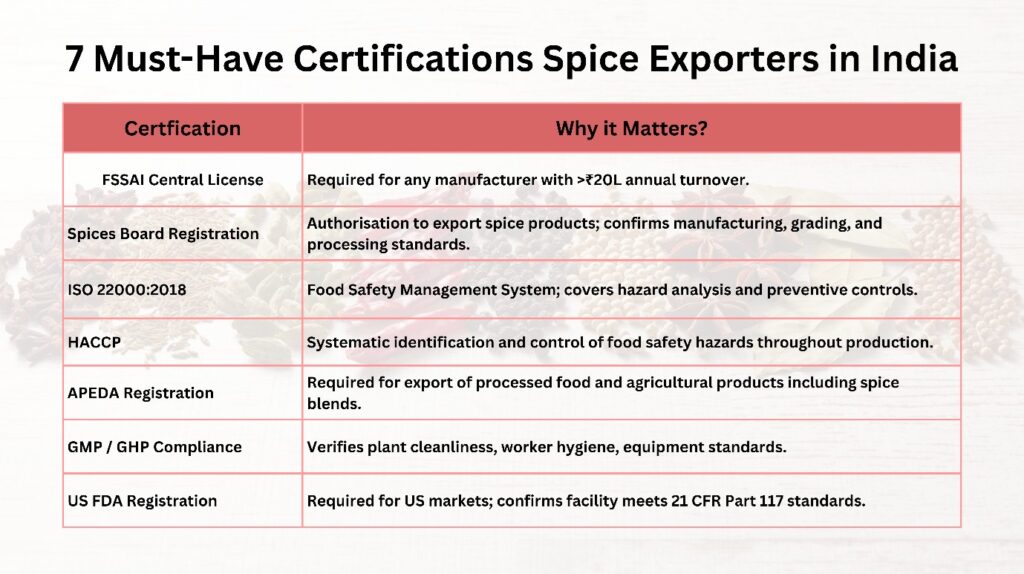
- FSSAI Central License: Compliance with India’s Food Safety and Standards Act; required for any manufacturer with > ₹20L annual turnover.
- Spices Board Registration: Authorisation to export spice products; confirms manufacturing, grading, and processing standards.
- ISO 22000:2018: Food Safety Management System; covers hazard analysis and preventive controls.
- HACCP: Systematic identification and control of food safety hazards throughout production.
- APEDA Registration: Required for export of processed food and agricultural products including spice blends.
- GMP / GHP Compliance: Good Manufacturing/Hygiene Practices; verifies plant cleanliness, worker hygiene, equipment standards.
- US FDA Registration: Required for any product sold in the US market; confirms facility meets 21 CFR Part 117 standards.
As of 2026, FSSAI has significantly tightened its digital verification infrastructure. The FoSCoS portal now includes geo-tagging of business locations, meaning you can cross-check whether the registered address matches the actual operating facility. This is a powerful tool that most buyers never use.
The TRACE Framework: 5 Steps to Authenticate a Food Seasoning Manufacturer
After decades of vetting suppliers across India, we’ve distilled our due-diligence process into a repeatable framework called TRACE. Follow this framework before signing any agreement with your potential spice partner.
- T – Track the License
Every legitimate seasoning manufacturer in India operates under a 14-digit FSSAI Central License. Get the 14-digit number. Verify it on FoSCoS. Confirm the product category matches what you’re sourcing. Check the expiry date, renewal status, and as of 2026, cross-reference the geo-tagged business address against the actual processing facility location.
What you’re really testing: Does a legal, verifiable manufacturing identity exist?
- R – Register Against Official Databases
For any export transaction, the manufacturer must be registered with the Spices Board of India. Cross-check with the official member directory at indianspices.com. If they supply to EU, US, or Middle Eastern markets, APEDA registration is equally non-negotiable.
What you’re really testing: Is this manufacturer operating within India’s export compliance infrastructure or outside it?
- A – Analyse the Lab Documentation
Ask for a COA (Certificate of Analysis) from a NABL-accredited laboratory. The COA must cover pesticide residue panels, microbial counts (TPC, Salmonella, E. coli), moisture content, and active compound levels such as curcumin for turmeric or capsaicin for chilli. What separates serious manufacturers is that they test every batch, not once a year.
What you’re really testing: Is quality being measured or merely claimed?
- C – Check the Facility in Person
Visit the processing unit. Look for: separated raw/finished goods storage, hygienic processing floors, functional metal detectors, documented SOPs, and trained QC staff. The manufacturers who have nothing to hide will invite you without hesitation. The ones who stall or redirect are giving you your answer.
What you’re really testing: Does the infrastructure exist to deliver what the paperwork promises?
- E – Examine the Export Trail
Ask for DGFT export data or Shipping Bill references from the past 24 months. A manufacturer supplying consistently to EU, US, or Japanese markets has already been tested by the world’s strictest food safety regulators and passed. That track record is the most credible third-party validation available, and no brochure can substitute for it.
What you’re really testing: Has this manufacturer’s quality been validated by regulators who answer to no one in India?
This is the very framework that’ll help you find the most authentic and the best seasoning manufacturers in India.
Red Flags: 8 Signs to Walk Away from a Supplier
Experience teaches you as much about what to avoid as what to seek. These are the signals that have protected our supply chain over the years:
Walk Away If You See These:
- FSSAI license number that doesn’t verify on the FoSCoS portal, or shows as expired / cancelled
- No physical processing plant; manufacturer operates from an office, warehouse, or residential address
- Unable to provide a NABL-accredited COA for their product
- Price that is 30%+ below market rate without a credible explanation (adulteration is usually the reason)
- Unwilling to share the source/origin of raw materials or farmer networks
- “Organic” claims without NPOP or equivalent certification and valid transaction certificates
- No export history despite claiming to supply to international clients
- Communication only over WhatsApp with no formal letterhead, GST registration, or verifiable business address
Final Thoughts
Finding authentic food seasoning manufacturers in India is not a matter of luck or relationship; it is a matter of process. The right manufacturer will welcome your scrutiny. They’ve earned the right to, because they’ve built systems that stand up to it.
India’s spice heritage spans millennia. Our role in this industry whether as manufacturers, buyers, or brands, is to ensure that when a consumer opens a jar of Indian seasoning anywhere in the world, what they experience is exactly what it claims to be.
Source authentic seasonings from a manufacturer you trust. At VLC Spices we’ve maintained our partners’ trust for over 30 years. If you’re in search of a reliable seasoning manufacturer in India, connect with us today!
Frequently asked questions
What is the difference between a trader and a seasoning manufacturer?
A manufacturer operates a processing facility and controls production, quality, and sourcing. A trader typically buys and re-labels products, often with limited visibility into origin or safety standards.
How can I check the quality of a seasoning before buying in bulk?
Request a NABL-accredited lab Certificate of Analysis (COA) for the exact batch. This should include pesticide residue, microbial counts, and active ingredient levels and not just basic specs.
How do I evaluate a seasoning manufacturer in India without visiting in person?
For global importers who can’t visit the facility in person can rely on multiple verification methods including quality certificates, export licenses, and test reports or requesting a virtual facility tour is a viable alternative.