Black Pepper, Chilli, and Cumin: The High-Usage Seasonings Every Food Manufacturer Should Have a Reliable Source For
A QSR chain scaling from 50 to 200 outlets starts getting complaints about inconsistent heat in their signature sauce. After weeks of troubleshooting, they trace it back to one thing: a supplier switch for chilli powder. Different variety, different moisture, different heat profile compared to previous batch
This happens more often than most food businesses admit. And it almost always involves one of three seasonings: black pepper, chilli, or cumin. These are the highest-volume, most cross-functional spices and most adulterated in food production.
VLC Spices who are one of the food seasoning manufacturers in India who supply these at scale understand this better than anyone.
Why These Three Are in a Different League
Black pepper, chilli, and cumin are used in production week after week. If your supplier cannot deliver them consistently, it becomes more than a small problem. It can disrupt your entire supply chain.
According to IBEF, India exported 1.799 million tonnes of spices worth US$4.72 billion in FY 2024-2, a 17% increase over the previous year, with chilli and cumin leading export volumes. The global demand for these three tells you how central food seasoning manufacturers are to food businesses.
Black Pepper: The Seasoning That Crosses Every Cuisine
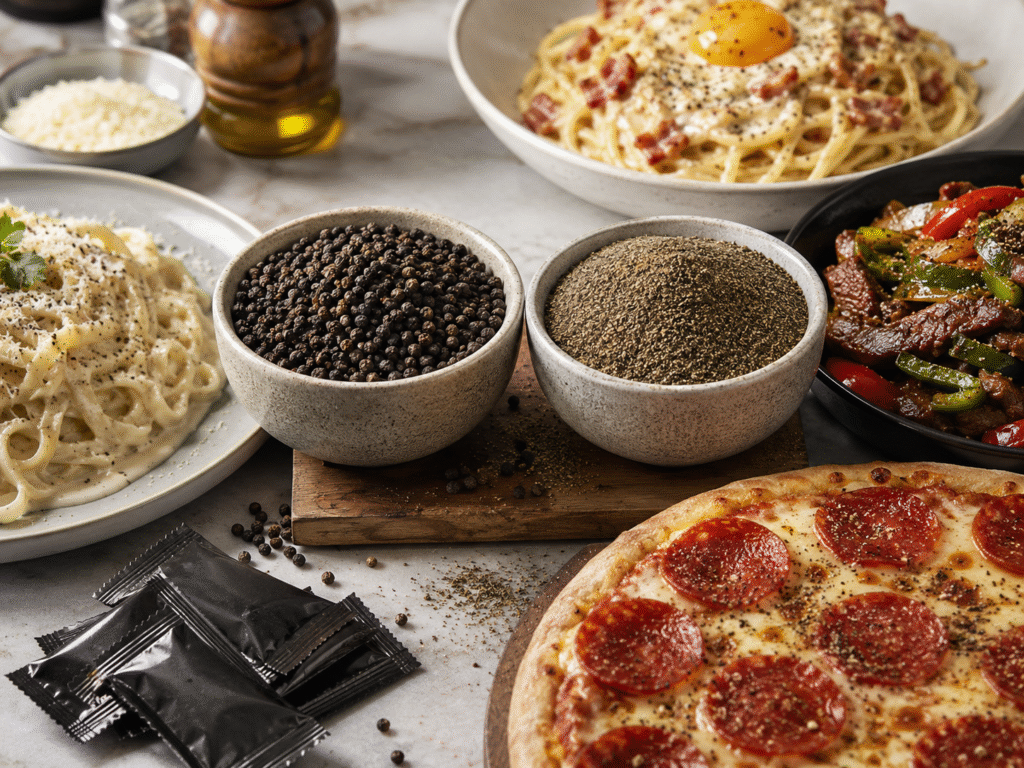
Black pepper shows up across more food categories than almost any other spice.
Industry | Application | Why Consistency Matters |
Italian and continental food | Cacio e Pepe, Alfredo sauces, pasta seasonings | Piperine content defines heat intensity in the final product |
Processed meats | Pepperoni, sausages, deli cold cuts | Inconsistent grind size causes uneven distribution in the meat blend |
Hotel and airline catering | Pepper sachets, pre-seasoned meal kits | Ultra-fine, uniform powder is a non-negotiable specification |
Snack manufacturing | Seasoning coatings, dry rubs | Mesh size must be standardised across every batch |
Quality markers to demand per batch:
- Piperine content declared on COA
- Moisture at or below 12%
- Mesh size between 40 to 60 for powder
- Third-party lab test report, not just a supplier certificate
Chilli: The Highest Compliance Risk in Your Procurement List
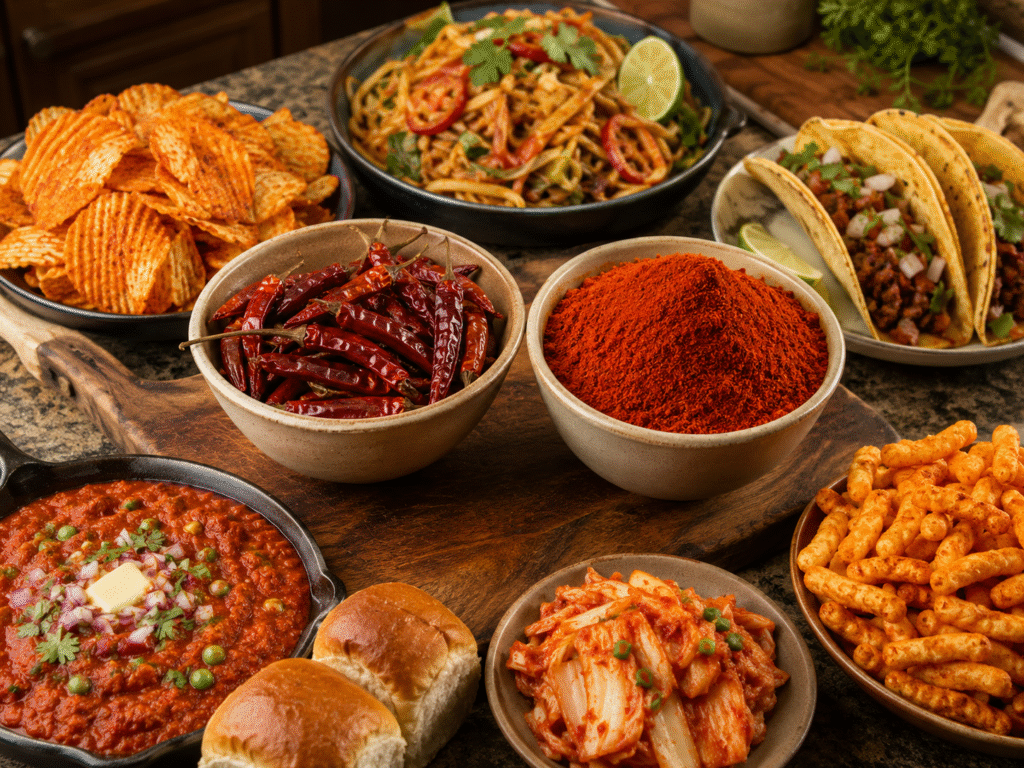
Chilli is India’s single largest spice export by volume. It is also the spice where a quality failure causes the most visible and costly damage.
How different industries use it:
Industry | Application | Why Consistency Matters |
South Asian packaged food brands | Curry bases, biryani masalas, ready-to-cook kits | ASTA colour value and Scoville heat must match across every batch |
Korean and Japanese food manufacturers | Gochujang base, kimchi seasoning, ramen spice blends | Specific heat range and colour profile required as wrong variety can break the formulation |
Mexican and Tex-Mex food brands | Taco seasoning, enchilada sauce, salsa mixes | Heat consistency is critical as chilli is the dominant flavour driver |
Snack manufacturers | Chip coatings, namkeen seasoning, extruded snack dusting | Batch inconsistency in heat or colour gets amplified during coating and is felt immediately by the consumer |
QSR chains and food service | Signature sauces, marinades, spice blends | Colour and heat must be identical across bulk orders to maintain brand consistency across outlets |
Two compliance risks you cannot ignore
Sudan dye and aflatoxin contamination are two major compliance risks in chilli sourcing, especially for brands supplying export or regulated markets. Since these issues cannot always be detected visually, working with suppliers who follow lab testing, controlled drying, and proper storage practices is essential to protect product quality and avoid recalls or rejections.
Market-specific requirements at a glance:
Market | Requirement |
European retail and private label | ASTA 120+ colour value |
Middle East | Halal certification |
United States | USFDA registration and pesticide residue compliance |
General export | Spice Board of India registration |
Cumin: Where Aroma Is the Entire Product
Cumin anchors the flavour profile of shawarma rubs, falafel mixes, taco blends, chilli con carne spice mixes, and dozens of other products across Middle Eastern, South Asian, and Latin American cuisines.
For manufacturers supplying food processors in the UAE, Saudi Arabia, or Kuwait, Halal-certified cumin with a minimum volatile oil content of 2 to 3% is the baseline. Below that, the aroma does not come through in heat-processed ready meals.
Industry | Application | Why Consistency Matters |
Middle Eastern food manufacturers | Shawarma rubs, falafel mixes, hummus seasoning | Volatile oil content (min 2-3%) defines aroma intensity in heat-processed products |
Mexican and Tex-Mex food brands | Taco seasoning, chilli con carne spice mixes, burrito blends | Cumin is the primary flavour note — any aroma drop is immediately noticeable |
European ready meal brands | Moroccan-style tagines, Indian meal kits, frozen Middle Eastern lines | Microwaving amplifies or kills aroma depending on volatile oil quality at source |
Ayurvedic and health food brands | Jeera water, digestive supplements, functional food blends | Organic certification and origin traceability are increasingly demanded by buyers |
Industrial tempering lines | Slow-cook sauces, curry bases, restaurant supply | Whole seeds must be uniform in size for even heat release during tempering |
Whole Seeds vs. Powder
- Whole cumin seeds: Better for tempering-based production lines where seeds are added to hot oil
- Cumin powder: Better for dry rubs, seasoning blends, and spice sachets
Either way, origin matters. Rajasthan and Gujarat produce the majority of India’s cumin supply. Origin-specific sourcing gives you traceability and a predictable quality profile that open-market procurement cannot.
What to Ask Any Supplier Before You Commit
Whether you are working with food seasoning suppliers from India, food seasoning wholesalers, or food seasoning exporters India, these are non-negotiables before signing a supply agreement:
- Ask for three consecutive batch COAs: One sample tells you what a supplier can do on a good day. Three consecutive batches tell you if they can do it consistently.
- Verify third-party testing: NABL-accredited or SGS-certified lab reports carry more weight with international buyers than supplier self-certification.
- Check packaging flexibility: You need 25 kg HDPE bags for industrial lines, vacuum-sealed packaging for cumin, and retail-ready formats for private label. A supplier who cannot match your production format adds cost and risk.
- Ask where they source from: Direct procurement from farming regions in Rajasthan, Andhra Pradesh, or Kerala gives you traceability. Spot buying from commodity markets does not.
These are necessary precautions, as every bad dish, every bad review on the internet can lead to less customers and huge financial losses.
Why India Is Still the Right Source
India is the world’s largest producer and exporter of spices. For buyers in the Middle East, Africa, Europe, and South Asia, sourcing from Indian food seasoning wholesalers means shorter transit times, better pricing, and fresher product at destination.
The more important point: Certified Indian suppliers who have invested in proper processing, testing, and documentation infrastructure now match global quality standards, not just on price but on compliance. That is what makes them viable long-term production partners, not just low-cost vendors.
The Bottom Line
Black pepper, chilli, and cumin are not interchangeable commodities. Each has specific quality benchmarks, adulteration risks, and compliance requirements that vary by market.
A supplier who handles all three, maintains batch consistency, and backs every shipment with verifiable documentation is not just a vendor. They are a production partner.
VLC Spices are one of the best food seasoning exporters in India which supplies certified, lab-tested black pepper, chilli, and cumin in whole and ground forms. They also have flexible packaging options and complete export documentation for buyers across the Middle East, Europe, North America, and South Asia.
Along with chilli, cumin, and chilli you can also check out our fennel seeds, cloves, ginger powder, chilli flakes, green cardamom, white onion powder, mace and other spices. Request a sample TODAY.