Why QSR Chains and Masala Blenders Need Different Coriander Powder Specs, Even from the Same Manufacturer
Most food businesses assume coriander powder is a single, standard product. Buy it from any supplier, and you get the same thing. But this is not true.
The same coriander powder manufacturers can, and should, supply very different specs depending on who the buyer is. A QSR chain and a masala blender may order from the same factory, yet they need that powder to fulfil different roles.
In this blog, we have broken down why you might need different type of coriander powder based on your requirement, and what it means for your sourcing decisions.
What a QSR Chain Actually Needs
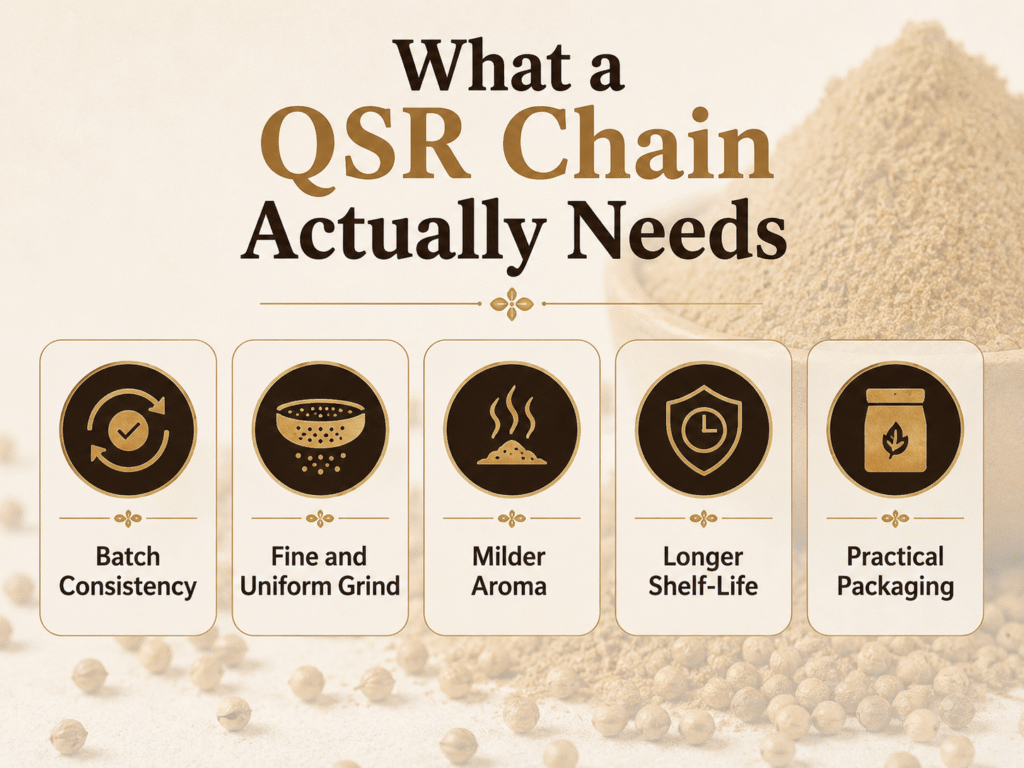
Quick service restaurants like McDonald’s, KFC, Domino’s Pizza runs on consistency. A customer in Mumbai should get the same taste as a customer in Delhi. This shapes everything about the coriander powder they need.
Here is what matters most for QSR buyers:
- Batch to batch consistency: The flavour has to match every single time, at every outlet.
- Fine, uniform grind: This helps the powder mix evenly into marinades, sauces, and coatings.
- Milder aroma: A powder that is too strong can throw off a recipe that is meant to taste the same across hundreds of locations.
- Longer shelf stability: QSR supply chains often move through central kitchens and cold storage, so the powder needs to hold its quality over time.
- Practical packaging: Smaller bulk units that are easy to pour and use daily in a busy kitchen.
For a QSR chain, the coriander powder is one small part of a large, standardised system. It cannot be the variable that breaks consistency.
What a Masala Blender Actually Needs
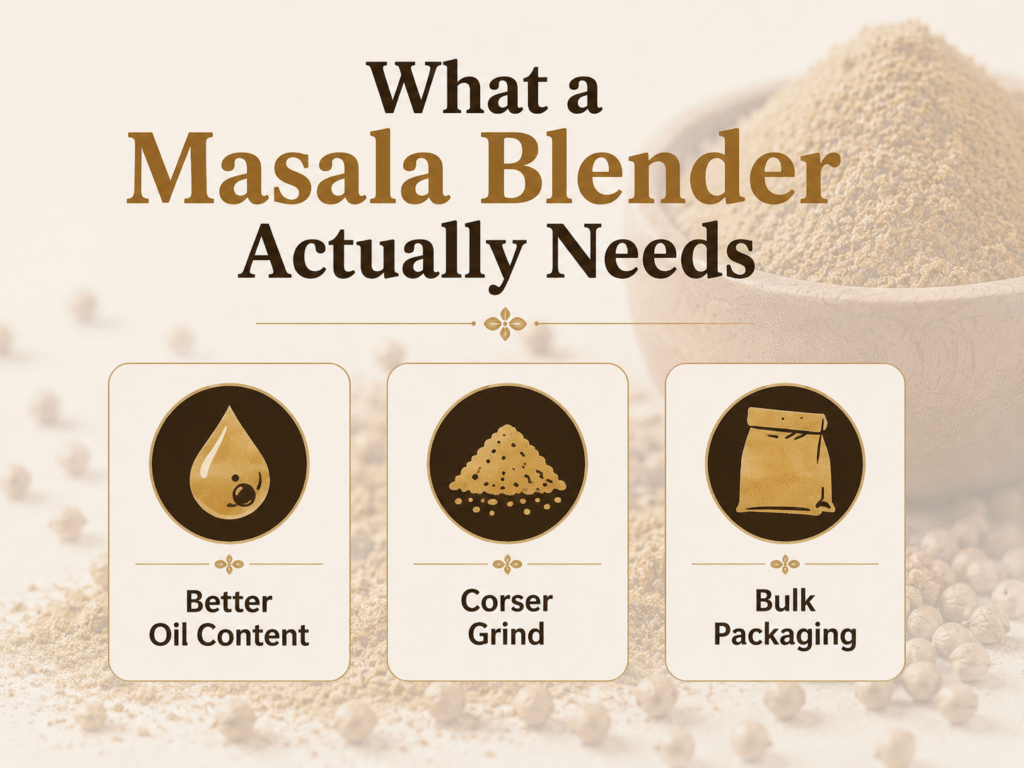
Masala blenders have a very different job. Coriander is often not a background note in their blends. It is a flavour anchor.
Their priorities look quite different:
- Strong volatile oil content: This is what gives coriander its real aroma and taste, and blenders often want this at a higher level.
- Coarser or customisable grind: The right texture depends on the specific blend being made.
- Some batch variation is fine: For artisanal or regional blends, small natural differences are often expected, sometimes even valued.
- Tolerance for colour variation: Since the powder gets mixed with other spices, small shade differences are not usually a problem.
- Bulk packaging: Think 25kg bags built for further processing, not direct use in a kitchen.
A masala blender is not looking for uniformity. They are looking for character and strength that can carry through a complex spice mix.
Side by Side Comparison
Requirement | QSR Chains | Masala Blenders |
Grind size | Fine, uniform | Coarser, customisable |
Aroma strength | Mild, controlled | Strong, pronounced |
Batch consistency | Very high priority | Some variation acceptable |
Shelf life | Long, stable | Moderate |
Colour variation | Low tolerance | Higher tolerance |
Packaging | Smaller, kitchen-ready units | Bulk bags or drums |
This table shows just how different these two buyer types are, even though both are technically ordering “coriander powder.”
Why This Matters for Sourcing Decisions
If a supplier only offers one type of coriander powder, they are likely serving one type of buyer well and underserving the other.
This is an important thing to check when you look for coriander powder suppliers. A manufacturer who cannot explain their grind size options or oil content range probably is not customising much at all. They are likely selling the same product to everyone.
Before you sign a supply contract, it helps to ask a few direct questions:
- What grind sizes can you produce, and can I get a sample of each?
- What is the volatile oil content range for your coriander powder?
- Do you offer a Certificate of Analysis with each batch?
- How do you handle consistency across large orders?
- Can you adjust the spec based on my specific use case?
These questions quickly tell you whether you are dealing with a manufacturer built for serious food businesses, or one just moving generic stock.
Finding the Best Coriander Powder in India
India is home to some of the largest coriander growing regions in the world, and this is part of why many food businesses look here first. But growing region alone does not guarantee the right product for your business.
The best coriander powder in India is not one single grade. It depends on what you are making. A QSR brand and a masala blending company sourcing from the same region, even the same farm, may still need two very different final products.
This is also true for coriander powder exporters shipping to international markets. A buyer in the US making a spice blend has different needs than a QSR brand in the Middle East building a standardised menu. The manufacturer needs to understand this difference before the order is even placed.
How to Communicate Your Spec Needs to a Manufacturer
Getting the right coriander powder starts with clear communication. A few practical tips:
- Ask for sample batches at different grind levels before committing to a bulk order.
- Request lab data on oil content, moisture, and ash content, not just a general quality claim.
- Explain your exact use case upfront. Tell the supplier if the powder is going into a marinade, a dry rub, or a spice blend.
- Ask how they handle repeat orders. Will the spec stay the same, or can it shift slightly batch to batch?
Being specific here saves time and prevents quality issues down the line.
Conclusion
There is no single “best” coriander powder that works for every food business. What works for a QSR chain will likely disappoint a masala blender, and the other way around.
The right coriander powder manufacturers understand this difference and build their process around it, rather than offering one generic product to every buyer. If you are sourcing coriander powder for your business, look for a supplier who asks about your use case before quoting a price. That question alone tells you a lot about how seriously they take quality and customisation.
Looking for a manufacturer and supplier who can customise coriander powder according to your business requirement, you should check out VLC Spices. Our facility is equipped with advanced machinery that helps us control moisture and even control temperature during the grinding process that helps to retain temperature and essential oils.
Along with coriander powder, you can also check out our chilli powder, black pepper powder, turmeric powder, or even our customised spice mix. Contact us TODAY!